A 74-year-old man presents to his GP with recurrent dizziness and one episode of near-syncope. His pulse is regular at 36 beats/min and his blood pressure is 108/64 mmHg. The ECG is shown below.
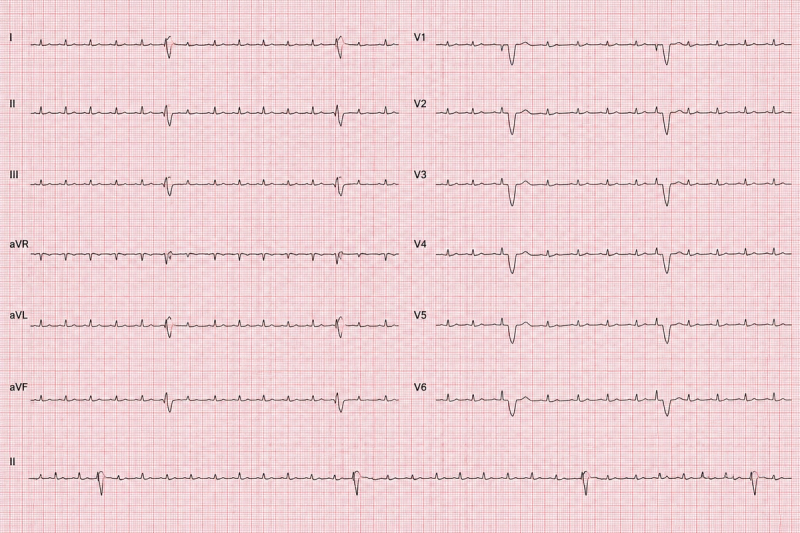
Which ECG diagnosis is most likely?
The ECG demonstrates atrioventricular dissociation: regular P waves occur at a faster rate than the regular QRS complexes, with no consistent relationship between them. This indicates complete atrioventricular block, with an escape rhythm maintaining the ventricular rate.
Atrial fibrillation would produce absent organised P waves and an irregular ventricular rhythm. First-degree block has a prolonged but constant PR interval, while Mobitz type I block shows progressive PR prolongation before a dropped QRS complex. Sinus bradycardia retains a P wave before every QRS complex.
His near-syncope and marked bradycardia require immediate hospital assessment by emergency ambulance because urgent pacing may be needed.